
This media hub packages the existing 2026 Mushroom Wellness Transparency Report into citation-ready assets: a branded media brief, report PDF, consumer checklist, scoring rubric, infographic, transparent iMD logo file, citation sheet, approved short summaries, and source links. It is designed for journalists, newsletter editors, directories, podcast researchers, educators, and consumer-safety writers who need a clean source without linking to a product page.

Media-use note. This page is education-only. It is not medical advice, legal advice, a safety certification, a product endorsement, or a recommendation to use any substance. The report evaluates public-facing transparency signals only.
Primary Report Links
| Asset | Use | Link |
|---|---|---|
| Report hub | General entry point for the full report cluster | Open report hub |
| Full report overview | Primary citation URL for articles and references | Open full report overview |
| Brand audit summary | Summary of the 101-entry audit findings | Open brand audit |
| 100-point score | Scoring methodology and transparency dimensions | Open scoring rubric |
| 10 questions checklist | Consumer-facing checklist | Open checklist |
| .net quick-read companion | 90-second version and data-product framing | Open .net quick read |
| .net data hub companion | Crawlable 101-entry dataset plus CSV/JSON downloads | Open .net data hub |
Downloadable Branded Media Assets
These files are intended for journalists, newsletter editors, directories, podcasters, educators, and consumer-safety writers who need a concise reference instead of a long article page.
| Asset | Format | Best use | Download |
|---|---|---|---|
| 2026 Report - Media Edition | Attach to media pitches or cite as a concise report summary | Download PDF | |
| Media Brief | One-file press summary with key findings and quote | Download PDF | |
| 10 Questions Checklist | Consumer checklist for newsletters and resource pages | Download PDF | |
| 100-Point Scoring Rubric | Explains the ten scoring dimensions and grades | Download PDF | |
| Infographic | SVG | Embed or share as a visual summary with logo included | Open SVG |
| Transparent iMD logo | PNG | Brand reference for media use | Open PNG |
| Citation sheet | TXT | Copy/paste citation, summaries, links, and usage boundary | Open TXT |
| Rubric spreadsheet | CSV | Simple scoring dimensions for editors and researchers | Open CSV |
Suggested Citation
APA-style citation:
iMicrodosing.org Research & Editorial Team. (2026). 2026 Mushroom Wellness Transparency Report & 101-Entry Audit. iMicrodosing.org. https://imicrodosing.org/mushroom-wellness-report/mushroom-wellness-report-overview/
Plain-language citation:
The 2026 Mushroom Wellness Transparency Report by iMicrodosing.org reviewed public-facing mushroom wellness product pages using a 100-point framework covering lab testing visibility, ingredient disclosure, claim restraint, legal disclosures, support access, shipping transparency, reviews, and refund clarity. [1] analysis 2026 Mushroom Wellness Transparency Report & 101-Entry Audit Link →
Approved Short Summaries
25-word version
The 2026 Mushroom Wellness Transparency Report reviews how clearly mushroom wellness brands disclose testing, ingredients, claims, safety language, legal context, and consumer protections.
50-word version
The 2026 Mushroom Wellness Transparency Report from iMicrodosing.org is a consumer-focused audit and transparency framework for mushroom wellness product pages. It evaluates public-facing disclosures across ten dimensions, including COA visibility, lab panel clarity, ingredient transparency, medical-claim restraint, legal disclaimers, support availability, reviews, shipping, and refund clarity.
100-word version
The 2026 Mushroom Wellness Transparency Report from iMicrodosing.org reviews consumer-facing transparency across the mushroom wellness market. The report applies a 100-point framework to public product-page information, examining COA visibility, lab panel clarity, ingredient transparency, dosage clarity, medical-claim restraint, legal disclaimers, support availability, shipping transparency, review visibility, and refund or replacement clarity. The report is not a product endorsement, safety certification, medical recommendation, or legal analysis. It is designed as an education-first reference for consumers, journalists, directories, educators, and reviewers who need a clearer way to evaluate mushroom wellness product claims.
Approved Quote
“Consumers should be able to understand what a mushroom product is, what it contains, how it is tested, what claims are being made, what risks may apply, and who is accountable before they are asked to trust a product page.”
- iMicrodosing.org Research & Editorial Team
Media Brief: Key Findings
The 2026 report evaluated 101 scored market entries using 10 transparency dimensions and a 100-point scoring framework. [2] analysis Brand Transparency Audit Executive Summary Link →
The live .net companion summarizes the report as a data product and states that the dataset includes 101 reviewed entries, evidence captured from product, about, policy, lab, BBB/Trustpilot where available, and fields including brand, category, URL, COA, ingredients, claims, contact, and score. [3] reference 2026 Mushroom Wellness Report — 2026 Quick Guide Link →
The .net data hub adds a crawlable 101-entry dataset and states that public source URLs are intentionally omitted from the distributed table, CSV, and JSON so the dataset remains educational rather than a referral directory. [4] reference 101-Entry Mushroom Wellness Audit Dataset Link →
The ten scoring dimensions are COA visibility, lab panel clarity, ingredient transparency, dosage clarity, medical claim restraint, legal disclaimers, support availability, shipping transparency, review visibility, and refund or replacement clarity. [5] analysis 100-Point Transparency Score Link →
Federal agencies have warned consumers about mushroom-containing products linked to serious adverse events, which is one reason the report treats lab testing, active-category clarity, and claim restraint as consumer-protection issues rather than cosmetic page details. [6] Government Investigation of Illnesses: Diamond Shruumz-Brand Chocolate Bars, Cones, & Gummies (June 2024) Link →
Consumer interest in microdosing and psychedelic-adjacent products continues to grow, making plain-language transparency more important for people trying to distinguish functional mushrooms, Amanita products, psilocybin-adjacent products, nootropic blends, and general wellness claims. [7] Institutional U.S. Psychedelic Use and Microdosing in 2025: Insights from a Probability-Based and Nationally Representative Survey Link →
What the Report Does Not Claim
This report does not claim that any product is safe, legal, effective, clinically validated, or appropriate for any individual.
It does not recommend products.
It does not verify product contents through independent lab testing.
It does not replace medical, legal, regulatory, or toxicology advice.
It evaluates whether a consumer can see meaningful transparency signals before making a decision.
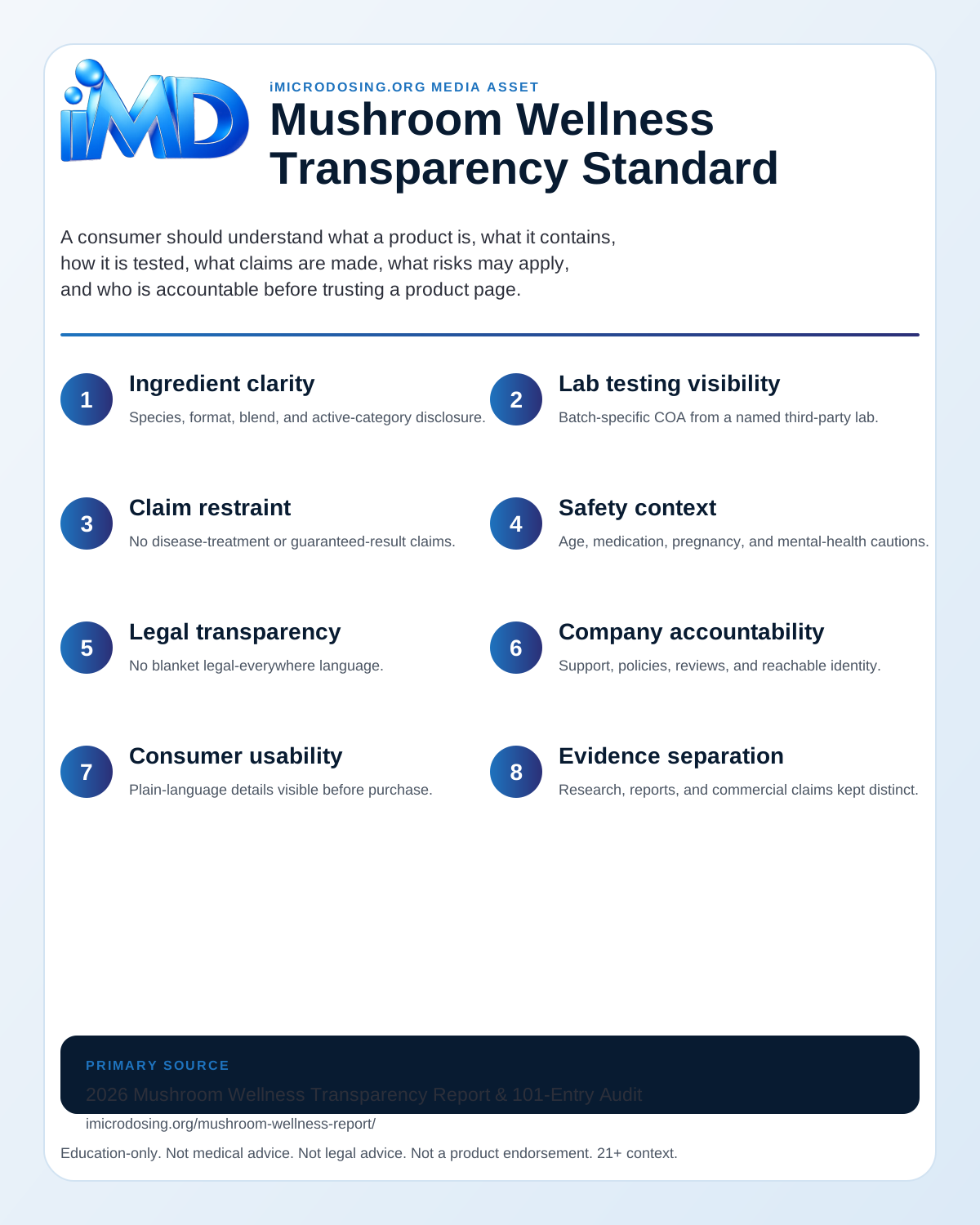
Embeddable Infographic
The SVG infographic below summarizes the consumer transparency standard and includes iMicrodosing branding inside the file itself. It can be embedded on outside resource pages with attribution to iMicrodosing.org.
Suggested Outreach Blurb
Use this version when sending the report to a journalist, newsletter editor, directory, podcast host, or consumer-safety writer.
iMicrodosing.org recently published the 2026 Mushroom Wellness Transparency Report, a consumer-facing audit and framework reviewing how clearly mushroom wellness product pages disclose lab testing, ingredients, medical-claim restraint, legal context, reviews, shipping, support, and refund policies. The report is education-only and does not recommend products. It may be useful as a source for readers trying to understand mushroom product labeling and transparency.
Media Contact
For questions about the report, source usage, or corrections, use the public contact page:
When referencing the report externally, please link to the primary report overview rather than a product page.